
FOAMSTAB NXG
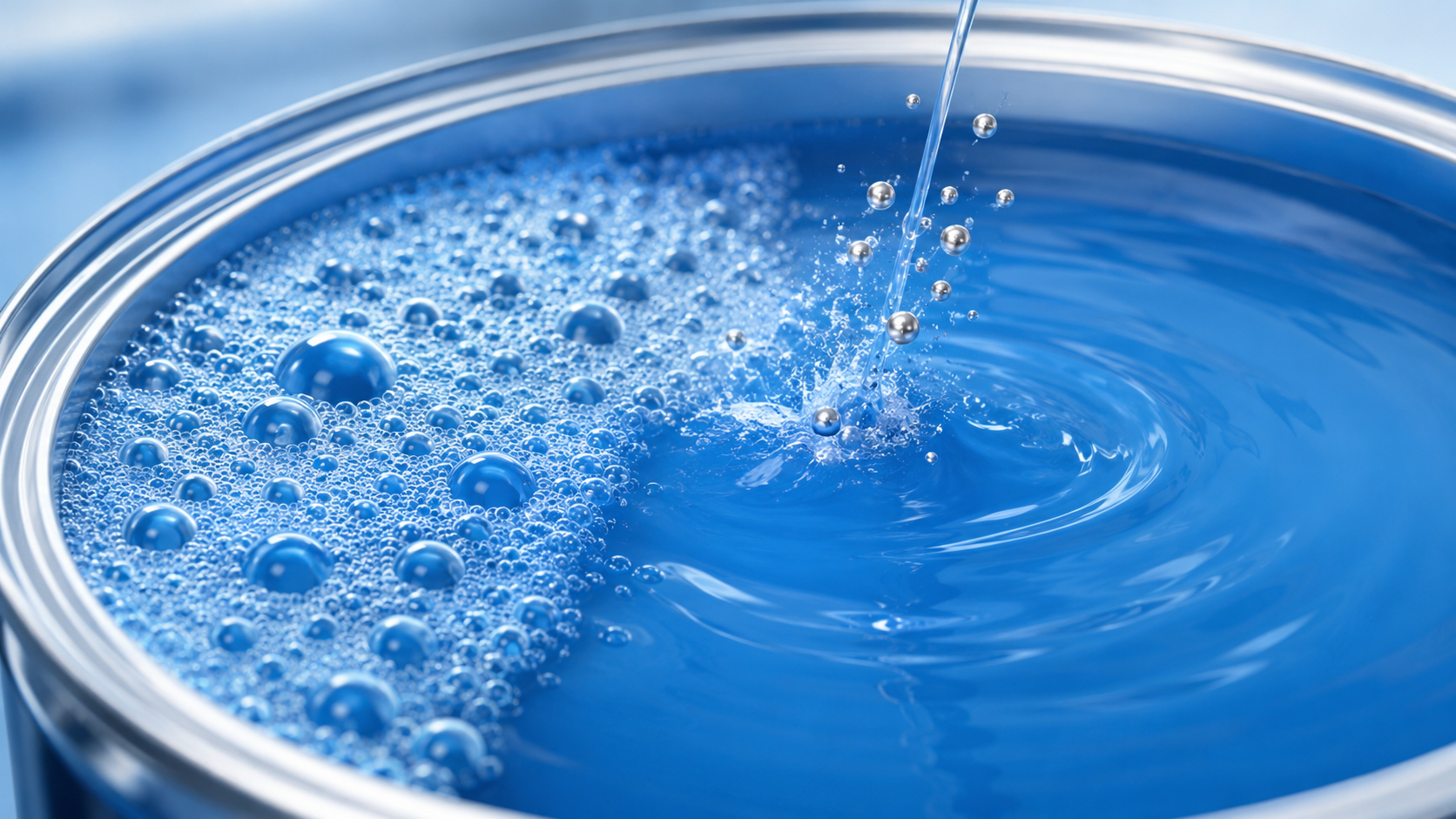
Advanced antifoam for waterborne formulations — especially surfactant-rich systems generating foam during dispersion, milling, pumping, and application.
Key Performance Benefits
-
Next-Gen Antifoam Technology
Advanced mineral oil and active particle synergy specifically engineered for modern, surfactant-rich aqueous formulations. -
Multi-Stage Process Efficiency
Rapidly collapses stubborn foam generated during high-speed dispersion, bead milling, industrial pumping, and roller or spray application. -
High-Surfactant Resilience
Effectively overcomes foam stabilization caused by aggressive wetting agents, dispersants, and emulsifier packages while maintaining long-lasting anti-foam performance. -
Defect-Free Film Finish
Disperses uniformly into aqueous binders to help prevent fish-eyes, surface cratering, and adhesion-related coating defects.
Recommended Applications
-
Surfactant-Rich Waterborne Coatings
High-performance architectural paints, decorative dispersion coatings, and waterborne industrial finishes. -
Pigment Grinding & Milling
Water-based pigment pastes, colorant concentrates, and mill-base grinding formulations. -
Aqueous Inks & Adhesives
Water-based flexographic printing inks, paper packaging adhesives, and latex-based sealants. -
Construction Emulsions
Polymer-modified cementitious slurries, masonry primers, and waterborne binder systems.
Typical Physical Properties
| Property Parameter | Test Specification / Unit |
|---|---|
| Chemical Description | Next-generation mineral oil compound with hydrophobic active particles |
| Appearance | Opaque, yellowish-amber fluid |
| Active Content | 80 – 100% Active Concentrate |
| Density (20°C) | 0.86 – 0.90 g/cm³ |
| Dispersibility | Easily incorporated into waterborne binder matrices |
Dosage & Processing Guidelines
The typical recommended dosage range for FOAMSTAB NXG is 0.1% to 0.5% calculated on the total formulation mass.
-
Split Incorporation
Add 50% during the grind or milling stage to prevent early foam buildup, and the remaining 50% during the let-down phase for long-term application stability. -
Mixing Conditions
Incorporate under standard production stirring to achieve homogeneous distribution throughout the waterborne formulation. -
Ladder Testing
Perform laboratory ladder testing to determine the minimum effective dosage based on the surfactant loading of the formulation.
Modern waterborne coatings and pigment concentrates rely heavily on complex wetting and dispersing additives, which often form dense, microfoam structures that standard mineral oil defoamers struggle to penetrate. FOAMSTAB NXG employs next-generation hydrophobic particle technology that rapidly destabilizes surfactant-rich foam membranes during high-shear milling and pumping without inducing surface defect fish-eyes.
Related Technical Articles & Case Studies
Next-Gen Defoaming Solutions for Surfactant-Heavy Waterborne Systems
Evaluating advanced mineral oil and active particle synergies for controlling persistent microfoam in modern surfactant-rich latex paint formulations.
Read ArticleControlling Foam During High-Shear Pigment Grinding & Milling
Best practices for introducing antifoams during the mill-base stage while maintaining excellent pigment dispersion and processing efficiency.
Read ArticleEliminating Application Microfoam in Waterborne Architectural Finishes
Root cause analysis of roller and spray application bubbles, with practical solutions for achieving smooth, defect-free architectural coatings.
Read ArticleNeed Our Services?
Call: +91 97695 93030
Work Hours
Mon – Sat: 9:00 AM – 6:00 PM IST
Email Us
support@geoconproducts.com