

Anti-Microbial Additives
Surface & Formulation Chemistry

Wetting & Dispersion Additives

Surfactant and polymeric dispersant chemistries that lower surface tension for faster, more complete wetting, and stabilize pigment, filler, and fiber particles against flocculation and settling — across nearly every liquid-formulated industry.

Function Wetting & particle stabilization Surface Tension Reduced to < 30 mN/m Typical Dosage 0.1–5% of formulation Industries Served 8+
2-IN-1 WETTING + DISPERSION
<30 mN/m* SURFACE TENSION CAPABILITY
0.1–5% TYPICAL DOSAGE RANGE
8+ INDUSTRIES SERVED
5-IN-1 FORMULATION BENEFITS
Introduction

Two functions, one formulation problem

Wetting and dispersion additives solve two related but distinct problems that show up in almost every liquid-based formulation: getting a liquid to fully contact a surface, and keeping solid particles evenly distributed within that liquid once they're in it.

Wetting agents are surfactants that lower the surface tension of a liquid — water, solvent, or resin — so it spreads across a substrate, penetrates a fiber, or coats a pigment particle more completely and more quickly. Without adequate wetting, formulations show craters, fisheyes, poor substrate adhesion, incomplete pigment wet-out, and uneven dye penetration.

Most formulation defects blamed on "bad pigment" or "bad resin" are actually wetting or dispersion failures.

Poor color strength, seeding, viscosity drift, dieback, and sedimentation in storage are frequently traceable to inadequate wetting or dispersion chemistry rather than the base raw materials themselves — which is why getting this additive class right has an outsized effect on finished product quality across paints, inks, construction chemicals, textiles, leather, and composite systems.
MECHANISM · WETTING

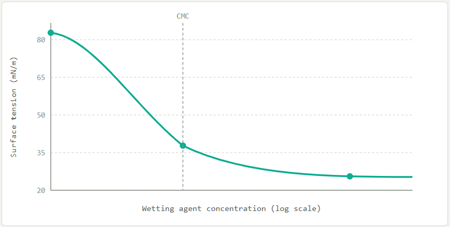
Surface Tension Reduction

Wetting agents concentrate at the liquid-air and liquid-solid interfaces, lowering surface tension sharply as concentration increases — until the critical micelle concentration (CMC) is reached, beyond which further addition has little extra effect.

Representative surfactant behaviour — pure water's surface tension (~72 mN/m) falls sharply with added wetting agent, plateauing near the critical micelle concentration.

Surface tension reduction with wetting agent concentration
MECHANISM · DISPERSION

Steric & Electrostatic Particle Stabilization

Dispersants stabilize pigments, fillers, and fibers by anchoring to the particle surface and creating a protective layer that prevents particles from coming together and forming unwanted agglomerates.

🎯
01
STEP 1 — ANCHORING

Adsorption onto the Particle

The dispersant's anchoring group binds to the pigment, filler, or fiber surface — via ionic, acid-base, or physical adsorption depending on particle chemistry.

🧬
02
STEP 2 — EXTENSION

Chain Extends into the Medium

A solvatable polymer chain or charged group extends outward from the particle surface into the surrounding liquid.

🛡️
03
STEP 3 — STABILIZATION

Particles Repel, Not Attract

The extended layer creates steric hindrance or electrostatic repulsion, keeping particles apart and preventing flocculation, settling, or re-agglomeration.

CHEMISTRY TYPES

Wetting & Dispersing Chemistries We Supply

A broad selection of wetting and dispersing chemistries designed to improve surface wetting, particle separation, formulation stability, and processing efficiency across demanding systems.

💧
01

Anionic Wetting Agents

Phosphate esters and sulfonate-based surfactants for aqueous systems needing strong, cost-effective surface tension reduction.

🌊
02

Non-Ionic Wetting Agents

Ethoxylated and acetylenic diol ("superwetting") surfactants for broad formulation compatibility and low-foam performance.

🧪
03

Polymeric Pigment Dispersants

Acrylic and hyperbranched block-copolymer dispersants with tailored anchoring groups for organic and inorganic pigments.

⚗️
04

Hyperbranched / Comb Dispersants

High-efficiency dispersants for nanofillers, carbon black, and difficult-to-wet inorganic pigments at low dosage.

🌀
05

Silicone-Based Wetting Agents

Organomodified siloxane surfactants delivering superspreading performance on very low-energy substrates.

🧴
06

Fluorosurfactant Wetting Agents

Fluorinated and PFAS-free super wetting chemistries for the most demanding low-surface-tension applications — see our FLUORODYNE range.

PERFORMANCE BENEFITS

What Good Wetting & Dispersion Chemistry Delivers

01
💧

Faster, More Complete Wet-Out

Reduces mill-base grind time and eliminates unwetted pigment agglomerates that show up as specks or seeds.

02

Higher Colour Strength & Gloss

Better pigment separation exposes more surface area per particle, improving tinting strength and film gloss.

03
📦

Storage Stability

Prevents hard settling, caking, and viscosity drift in stored formulations, extending shelf life.

04
🛡️

Reduced Flocculation & Seeding

Keeps particles individually stabilized instead of clumping into visible flocs or grit.

05
🔗

Improved Substrate Adhesion

Better wetting of the substrate itself reduces craters, fisheyes, and adhesion failures.

06
📈

Lower Viscosity at Higher Solids

Well-dispersed systems can carry higher pigment or filler loading without unworkable viscosity build-up.

INDUSTRIES SERVED

Where Wetting & Dispersion Additives Are Used

🎨
01

Paint & Coatings

Pigment wetting and dispersion in mill-bases, preventing flocculation and improving colour strength, gloss, and grind efficiency.

🖨️
02

Printing Inks

Pigment dispersion for offset, flexo, gravure, and inkjet inks, ensuring colour consistency and preventing pigment settling.

🏗️
03

Construction Chemicals

Cement particle dispersion in admixtures, pigment dispersion in coloured renders, and wetting agents in tile adhesives and redispersible powders.

🧵
04

Textile

Dye and pigment dispersion in printing pastes, wetting agents for faster dye-bath penetration, and levelling agents for uniform shade.

05

Metal Finishing

Wetting agents in plating and pretreatment baths for uniform deposition, plus dispersants in pigmented pretreatment coatings.

🧴
06

Leather

Dispersing agents for dyes, pigments, and fatliquors in leather finishing, and wetting agents for tanning liquor penetration.

🧱
07

Composites

Dispersing carbon fibre, glass fibre, and nanofillers such as CNTs and graphene uniformly through resin systems for consistent reinforcement.

🌾
08

Agrochemicals & Ceramics

Suspension concentrate stabilization in crop protection formulations, and particle dispersion in ceramic casting slips and slurries.

DOSAGE REFERENCE

Typical Addition Levels

Typical dosage ranges provide a starting point for formulation trials. Final addition levels should be established through application-specific testing.

Additive Type Typical Dosage Basis
Wetting Agents (Substrate / Liquid) 0.1–2% On total formulation weight
Pigment / Filler Dispersants 0.5–5% On pigment or filler weight
Superwetting Fluorosurfactants 0.05–0.3% On total formulation weight
Nanofiller Dispersants (Composites) 1–10% On filler weight, system dependent

Exact dosage depends on particle surface area, target loading, resin/solvent system, and required performance — run a trial mill-base or dispersion trial to confirm the right level for your formulation.

Frequently Asked Questions

WETTING &
DISPERSION

Technical and application questions about wetting and dispersing additives answered by Geocon Products' application specialists.

What is the difference between a wetting agent and a dispersing agent? +
A wetting agent lowers the surface tension of a liquid so it spreads and penetrates a solid surface more easily. A dispersing agent works on solid particles already in a liquid, adsorbing onto their surface and providing steric or electrostatic repulsion so the particles stay separated instead of clumping together or settling.
How do dispersing agents prevent pigment flocculation? +
Dispersing agents adsorb onto the pigment particle surface through an anchoring group, while a solvatable polymer chain extends into the liquid medium. This creates a physical (steric) or charge-based (electrostatic) barrier that keeps particles apart, preventing them from re-agglomerating into flocs.
What dosage of wetting or dispersing additive should I use? +
Typical addition is 0.1% to 2% on total formulation weight for wetting agents, and 0.5% to 5% on pigment or filler weight for dispersants, depending on particle surface area, target loading, and the specific resin or carrier system.
Can the same additive both wet and disperse a formulation? +
Some products are formulated to perform both functions, but the best results typically come from selecting a wetting agent optimized for substrate spreading and a separate dispersant optimized for the specific pigment or filler chemistry in the system.
Why does my formulation still show seeding or grit after adding a dispersant? +
This usually points to insufficient wetting before dispersion — if the wetting agent has not fully penetrated pigment agglomerates first, the dispersant cannot reach individual particle surfaces to stabilize them. Increasing initial wet-out time or wetting agent level often resolves it before adjusting the dispersant itself.
READY TO WETTING AGENTS

WETTING AGENTS IN YOUR FORMULATION?

Request a sample, get a quote, or speak with our technical team. We provide grade selection support, application guidance, and test samples for all MILLED GLASS FIBERS products.

Need Our Services?

Call: +91 97695 93030

Work Hours

Mon – Sat: 9:00 AM – 6:00 PM IST

Email Us

support@geoconproducts.com