

POTASSIUM FORMATE
HEAT TRANSFER FLUIDS
Inhibited secondary heat transfer fluid offering low viscosity down to -50°C, high specific heat capacity, non-toxicity, and low pumping energy in industrial cooling.
Next-Generation Low-Viscosity Sub-Zero Heat Transfer Fluid
Potassium Formate Heat Transfer Fluids represent an advanced, eco-friendly secondary refrigerant engineered specifically to replace traditional glycols (propylene/ethylene glycol) and calcium chloride brines in sub-zero industrial refrigeration systems. Formulated as a fully inhibited organic salt solution operating reliably from $-50^\circ\text{C}$ to $+120^\circ\text{C}$, this low-viscosity fluid exhibits exceptional thermophysical properties, including high specific heat capacity and high thermal conductivity. Unlike traditional glycols that experience severe viscosity spikes below $-10^\circ\text{C}$, Potassium Formate maintains low liquid flow resistance at deep sub-zero temperatures, drastically reducing pump electrical power consumption, improving heat exchanger overall heat transfer coefficients ($U$-values), and enabling smaller pump and piping dimensions. Combined with comprehensive multi-metal corrosion inhibitors, non-toxicity, zero ozone depletion potential (ODP = 0), and rapid environmental biodegradability, it provides optimal process cooling efficiency for pharmaceutical synthesis, food and beverage processing, commercial ice rinks, and industrial chillers.
Viscosity & Pumping Power Advantage Over Glycols
Examine the comparative thermophysical data showing why Potassium Formate Heat Transfer Fluids reduce pump work and maximize heat transfer efficiency at deep sub-zero temperatures down to $-50^\circ\text{C}$.
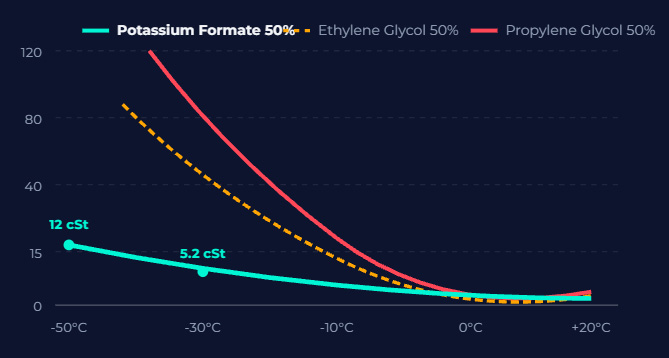
1. Kinematic Viscosity vs. Temperature (-50°C to +20°C)
Comparison of Kinematic Viscosity (mm²/s) between Potassium Formate 50% vs. Propylene Glycol 50% & Ethylene Glycol 50%
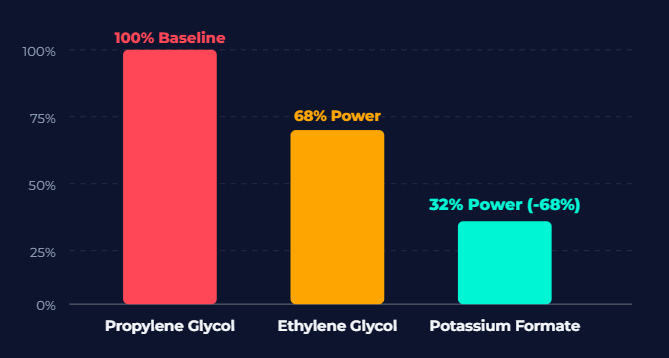
2. Relative Pumping Energy Savings at -30°C
Comparison of Pumping Electrical Power Requirement (kW) to Maintain Equivalent Heat Duty
Potassium Formate Heat Transfer Fluid features an organic alkali metal salt formulation that delivers up to 3x higher thermal conductivity than propylene glycol at $-30^\circ\text{C}$, resulting in dramatic reduction in evaporator surface area requirements.
Potassium Formate Secondary Fluid Metrics
Review key thermophysical parameters, operating temperature thresholds, and environmental indices for Potassium Formate Heat Transfer Fluids below.
-50°C to +120°C
Ultra-wide liquid phase thermal envelope suitable for deep freezing, process cooling, and thermal defrosting.
High Specific Heat & Conductivity
Exhibits heat conductivity up to $0.56\text{ W/m}\cdot\text{K}$, enabling exceptionally fast cooling response and superior heat flux.
Secondary Refrigerant & Chiller Fluid
Engineered as an energy-efficient liquid secondary coolant for industrial chillers, food freezing, and pharmaceutical processes.
Potassium Formate Heat Transfer Fluid provides significant thermodynamic and operational advantages over glycol secondary coolants.
Low Pumping Energy Requirements
Ultra-low kinematic viscosity at sub-zero temperatures reduces pump friction head loss, cutting electrical energy costs by up to 50–65%.
Superior Sub-Zero Heat Transfer
High thermal conductivity and turbulent flow regimes maximize heat exchanger heat flux ($W/m^2$) at $-40^\circ\text{C}$ operation.
Non-Toxic & Eco-Friendly
Zero Ozone Depletion Potential ($\text{ODP} = 0$) and Global Warming Potential ($\text{GWP} < 1$). Readily biodegradable organic salt chemistry.
Advanced Multi-Metal Corrosion Protection
Formulated with long-life organic corrosion inhibitors, protecting carbon steel, stainless steel, copper, brass, and cast iron.
Non-Flammable & Explosion-Proof
Aqueous salt solution has no flash point, eliminating fire hazards in enclosed production spaces and food processing halls.
Smaller Piping & Pump Footprint
High volumetric heat capacity allows lower circulation flow rates, enabling smaller pipe diameters and reduced capital expenditure.
Wlocation deployment across industrial chilling, sub-zero food processing, pharmaceutical crystallization, and sports facilities.
Food and Beverage Freezing
Non-toxic secondary coolant for blast freezers, spiral freezers, breweries, and dairy processing, replacing toxic ammonia in processing halls.
Pharmaceutical Process Cooling
Provides rapid heat extraction during exothermic reactor synthesis, batch crystallization, and sub-zero lyophilization units.
Ice Rinks and Sports Arenas
Circulates beneath ice surfaces at $-15^\circ\text{C}$ to maintain uniform ice hardness while reducing refrigeration compressor power demand.
Industrial Process Chiller Systems
High-performance liquid heat sink for central industrial chiller plants, environmental test chambers, and liquid-immersion cooling loops.
| Thermophysical Parameter | Testing Standard / Condition | Technical Value |
|---|---|---|
| Chemical Base | Formulation Chemistry | Inhibited Aqueous Potassium Formate ($\text{HCOOK}$) |
| Operating Temperature Envelope | Continuous Liquid Service | -50°C to +120°C (-58°F to +248°F) |
| Crystallization / Freezing Point | ASTM D1177 | < -50°C (Custom Concentration Available) |
| Density (20°C) | ISO 12185 / Hydrometer | 1.35 – 1.38 g/cm³ |
| Kinematic Viscosity (+20°C) | ASTM D445 | 2.1 mm²/s (cSt) |
| Kinematic Viscosity (-20°C) | ASTM D445 | 5.2 mm²/s (cSt) |
| Kinematic Viscosity (-40°C) | ASTM D445 | 12.0 mm²/s (cSt) |
| Specific Heat Capacity (+20°C) | Differential Scanning Calorimetry | 2.85 kJ/kg·K |
| Thermal Conductivity (+20°C) | Transient Hot Wire Method | 0.54 W/m·K |
| pH Value (Direct Fluid, 20°C) | ASTM D1287 | 8.0 – 9.5 (Inhibited Alkaline Buffer) |
| Environmental Index | OECD 301 Thermal Standard | ODP = 0, GWP < 1, Readily Biodegradable |
Potassium Formate Heat Transfer Fluid is pre-inhibited with organic corrosion passivators that form a protective monomolecular film over metal pipe surfaces.
Metallurgical Compatibility
• Recommended: Carbon Steel, Stainless Steel (304/316), Copper, Brass, Cast Iron, Rubber Seals (EPDM/NBR/FKM)
• Avoid: Unlined Zinc, Galvanized Steel, Magnesium Alloys
Bulk Packaging & Supply Options
Supplied ready-to-use (or concentrated format) in 210 Liter PE Drums, 1,000 Liter IBC Totes, and Stainless Steel ISO Tank containers.
Frequently Asked
Questions (FAQ)
Get quick, technically vetted answers regarding Potassium Formate Heat Transfer Fluids, sub-zero viscosity, glycol conversion, and corrosion protection.
Geocon Group — Eco-Friendly Heat Transfer & Secondary Refrigerant Division
Geocon Group manufactures and supplies high-performance Potassium Formate Heat Transfer Fluids, Potassium Formate 75% liquid, Calcium Formate, and specialty sub-zero secondary coolants across India and global markets. We provide hydraulic pumping power calculations, glycol conversion audits, and evaluation fluid sample dispatch from our corporate hub in Navi Mumbai and R&D facility in Bhandup.
Potassium Formate Secondary Fluid Applications at a Glance
Discover how Potassium Formate Heat Transfer Fluid slashes pumping energy, accelerates process cooling, and protects equipment across key industries.
Food Freezing & Cold Chain
Non-toxic secondary fluid operating at -40°C in spiral freezers and cold storage facilities with minimal pump power.
Pharma Chemical Reactors
Rapid heat dissipation in sub-zero chemical synthesis and crystallization reactors operating down to -50°C.
Ice Rinks & Process Chillers
Reducing chiller compressor work and power consumption by 50% compared to traditional propylene glycol brines.
Potassium Formate Heat Transfer Fluid
Connect with our Navi Mumbai technical sales desk to request evaluation sample kits, Technical Data Sheets (TDS), hydraulic pump calculations, or glycol conversion guidance.
Need Our Services?
Call: +91 97695 93030
Work Hours
Mon – Sat: 9:00 AM – 6:00 PM IST
Email Us
support@geoconproducts.com