
3M™ GLASS BUBBLES
K15
Versatile low-density bubble grade engineered for general resin filling, automotive body putties, lightweight caulks, and pourable polyurethane casting compounds.
Versatile Low-Density Resin & Sealant Density Trimming
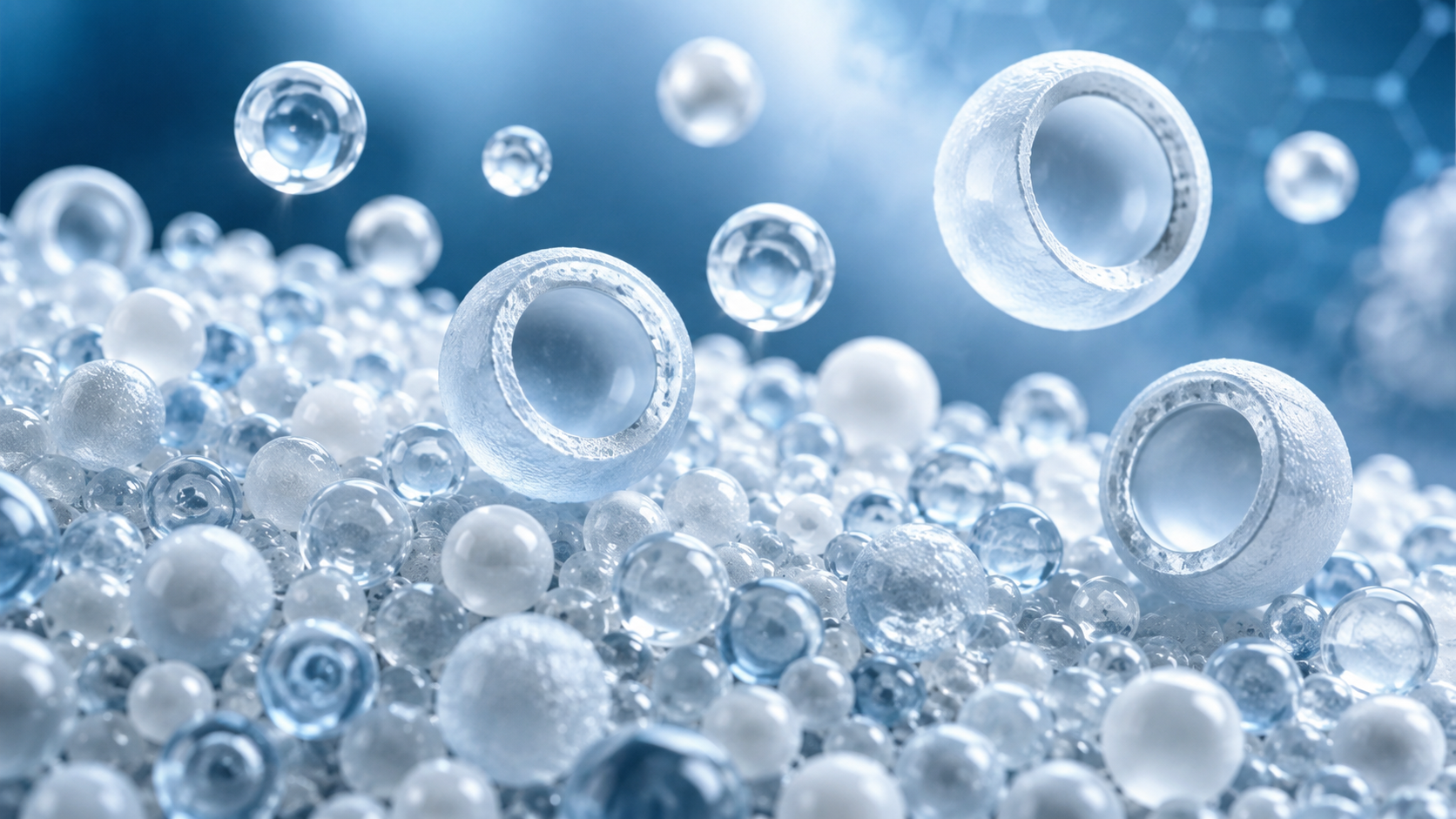
3M™ Glass Bubbles K15 represents a highly versatile, low-density, hollow glass microsphere grade engineered specifically for broad resin displacement and cost-effective volumetric expansion. Featuring a target true density of 0.15 g/cm³ and an isostatic crush strength of 300 psi (2.1 MPa), K15 balances lightweight performance with enhanced processing survival compared to lower-density variants. Composed of water-insoluble, chemically stable soda-lime-borosilicate glass, these smooth, non-porous microspheres serve as a functional filler that significantly reduces deadweight, lowers thermal conductivity, and prevents volume shrinkage in automotive body putties, architectural caulks, room-temperature vulcanizing (RTV) silicone sealants, and pourable polyurethane casting compounds. The smooth spherical geometry creates a ball-bearing effect within liquid resin systems, optimizing trowelability, improving sanding characteristics, and lowering raw material resin consumption.
3M™ Glass Bubbles K15 is specifically optimized for low-to-medium shear compounding processes where consistent density reduction, improved sandability, and cost-effective resin displacement are required.
3M™ Glass Bubbles K15 Performance Metrics
Review key physical parameters, density limits, and target matrix compatibility for 3M™ Glass Bubbles Grade K15 below.
0.15 g/cm³
Provides efficient density trimming and high volumetric yield expansion across general resin systems.
300 psi (2.1 MPa)
Offers enhanced sphere survival during low-to-medium stress mixing, pouring, and caulking applications.
Resins, Putties & Sealants
Engineered for automotive body putties, lightweight caulks, general resin filling, and polyurethane casting compounds.
3M™ Glass Bubbles K15 delivers an optimal combination of density reduction, viscosity management, and mechanical ease of finishing.
Efficient Weight Reduction
At 0.15 g/cm³, K15 displaces heavy mineral fillers to trim up to 25–35% of total formulation weight.
Enhanced Sandability
Reduces sanding resistance in body fillers and polyester putties, ensuring a smooth, pinhole-free surface finish.
Shrinkage & Sag Control
Non-porous rigid glass spheres reduce volumetric cure shrinkage and prevent vertical sag in thick sealants and caulks.
Ball-Bearing Flow Effect
Smooth, spherical shape lowers internal friction, improving spreadability and pumpability in casting compounds.
Chemical Stability
Inert borosilicate glass composition is water-insoluble and completely non-reactive with polyester, epoxy, and PU systems.
Resin & Cost Optimization
Replaces high-cost resin systems on a volume-for-volume basis, expanding batch volume per kilogram of raw material.
Deployed across automotive repair, architectural sealants, general resin compounding, and specialty thermoset casting.
Automotive Body Putties & Fillers
Substantially reduces body filler weight while providing effortless knife-troweling and fast, smooth sanding with reduced dust production.
Lightweight Caulks & Architectural Sealants
Prevents curing shrinkage and vertical slumping in acrylic, polyurethane, and silicone joint caulks while lowering package transport weight.
Pourable Polyurethane & Epoxy Casting Compounds
Enhances liquid resin flow into complex molds, reduces exothermic heat peaks during cure, and lowers finished part mass in thermoset casting.
General Resin Filling & Syntactic Composites
Serves as a multi-purpose density-trimming additive in unsaturated polyester, vinyl ester, and polyurethane resin formulations.
| Specification Parameter | Testing Standard | Technical Value | Commercial Significance |
|---|---|---|---|
| True Density | ASTM D2840 / 3M Test Method | 0.15 g/cm³ | Versatile density trimming for general resin & putty systems |
| Isostatic Crush Strength | ASTM D3102 / 3M Test Method | 300 psi (2.1 MPa) | 300 psi strength provides improved low-to-medium shear survival |
| Chemical Composition | XRF Analysis | Soda-Lime-Borosilicate Glass | Water-insoluble, non-combustible, chemically inert structure |
| Color / Appearance | Visual Inspection | White Free-Flowing Powder | High whiteness suitable for light-colored or pigmented products |
| Target Matrix Compatibility | Compounding Testing | Resins, Putties & Sealants | Universal compatibility with polyester, PU, epoxy & acrylics |
With an isostatic crush strength of 300 psi (2.1 MPa), 3M™ Glass Bubbles K15 offers higher shear survival than K1, but low-to-medium shear equipment is recommended for best results.
Low-to-Medium Shear Mixing
Introduce K15 during final let-down using planetary mixers, ribbon blenders, or low-speed agitators to preserve sphere integrity.
Storage & Handling
Store in sealed original packaging in a cool, dry warehouse to protect against ambient moisture absorption and dust generation.
Frequently Asked
Questions (FAQ)
Get quick, technically vetted answers regarding 3M™ Glass Bubbles K15 density, strength, compounding, and application matrices.
Geocon Group — 3M Specialty Glass Bubbles Division
Geocon Group supplies 3M™ Glass Bubbles K1, K15, K20, K25, K37, and high-strength iM series microspheres across India. We provide laboratory trial assistance, density matching, and sample dispatch from our corporate hub in Navi Mumbai and R&D lab in Bhandup.
3M™ Glass Bubbles K15 Target Applications at a Glance
Discover how 3M™ Glass Bubbles K15 enables general density trimming, exotherm control, zero shrinkage, and effortless sanding across key application fields.
Automotive Body Putties
K15 microspheres reducing body filler weight while providing effortless troweling and smooth sanding.
Lightweight Caulks & Sealants
Preventing shrinkage, slumping, and vertical sag in architectural joint sealants and caulks.
PU & Epoxy Casting Compounds
Improving resin flow into molds while controlling exotherm temperature spikes in thick casting parts.
3M™ Glass Bubbles K15
Connect with our Navi Mumbai technical sales desk to request evaluation sample kits, Technical Data Sheets (TDS), or pricing for 3M™ Glass Bubbles Grade K15 in Resins, Putties, and Sealants.
Need Our Services?
Call: +91 97695 93030
Work Hours
Mon – Sat: 9:00 AM – 6:00 PM IST
Email Us
support@geoconproducts.com