

Lightweight EV Battery Enclosures Using iM16K Glass Microspheres
Why iM16K specifically: Most glass bubble grades collapse under the packing pressures required for large, thick-walled automotive parts. iM16K's crush strength allows molders to run standard processing pressures on battery trays without sacrificing the lightweight benefits that hollow glass microspheres are designed to provide.
Lower compound density compared with mineral-filled compounds at equivalent stiffness.
More isotropic shrinkage across large, flat battery enclosure panels.
Improved thermal-expansion compatibility with adjacent metal brackets and busbars.
Improved flow and easier de-molding for thick-section, large-format components.
01 Polypropylene compounds
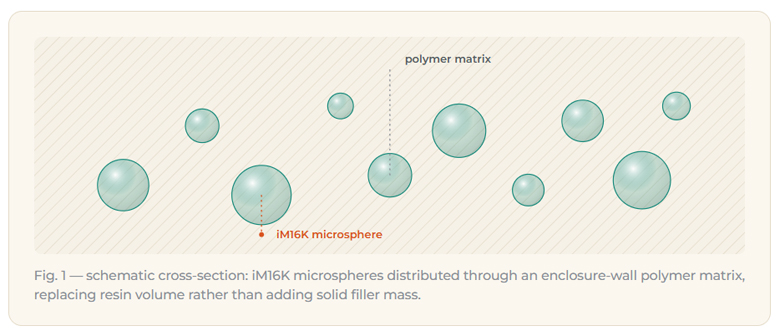
PP remains the workhorse resin for lower-voltage covers, cell separators, and interior enclosure trim. Loaded with iM16K, PP compounds shed significant weight versus talc- or glass-fiber-filled grades of similar stiffness, because the microspheres displace resin volume without adding mass the way solid mineral fillers do. The practical win for molders is dimensional: PP's naturally high shrinkage and warp tendency on large, thin-walled covers is noticeably tamed, since the spherical filler shrinks uniformly in all directions rather than orienting with flow the way fiber reinforcement does.
02 Polyamide compounds
Nylon 6 and 66 enclosure components — brackets, bus-bar carriers, structural ribs — benefit from iM16K in a different way: dimensional stability under thermal cycling. Battery packs see real temperature swings between charge, discharge, and ambient extremes, and PA parts with a lower, more isotropic coefficient of linear thermal expansion hold tolerance against metal fasteners and cooling-plate interfaces far better over the life of the pack. The added benefit of reduced density compounds the effect: lighter brackets, less mass hanging off the same mounting points.
03 Polyester (thermoplastic and SMC) compounds
For larger structural covers and trays, polyester systems — including sheet-molding-compound routes — carry a lot of the enclosure's surface area. Here, iM16K's contribution to dimensional stability across large, flat geometries is the headline: big panels are exactly where warpage shows up first, and a filler that shrinks the same way in every direction keeps those panels flat off the tool instead of needing secondary flattening or fixturing.
04 Thermoset compounds
In thermoset enclosure formulations — the systems used for the heaviest, most structural tray and lid components — iM16K's crush strength earns its keep during compression molding, where cavity pressures are highest and hold times longest. Density reduction here has an outsized payoff, since these are typically the largest, heaviest single parts in the enclosure assembly, and lower part weight also means easier handling during layup, demolding, and line transfer for components that can otherwise be awkward and heavy for operators and tooling to move.
05 What this adds up to on the line
Across all four resin families, the same four benefits repeat, just in different proportions depending on part geometry and process:
WEIGHT REDUCTION
Lower compound density at equivalent stiffness, since hollow spheres displace resin instead of adding solid mass.
DIMENSIONAL STABILITY
Spherical geometry shrinks isotropically, helping maintain dimensional tolerance where fiber-reinforced parts would distort with flow direction.
LOWER WARPAGE
Matched shrinkage across large, flat sections keeps enclosure panels flatter directly out of the mold.
EASIER HANDLING
Lighter, large-format components are easier to demold, transport, fixture and assemble throughout production.
If you're specifying an enclosure or tray program and want loading levels modeled against your resin system and wall thickness, our applications team can work through it with you against your part drawing.