

Why 16,000 psi Crush Strength Matters During Injection Moulding
The core idea: injection moulding doesn't apply one steady pressure — it applies several, back to back, in different parts of the machine, and each one is a chance for an under-rated filler to fail before the part is even formed.
Isostatic crush strength rating for iM16K (110 MPa)
Screw compresses filler during plastication, before injection even starts
Barrel and nozzle add mechanical and thermal stress on top of pressure
Cavity pressure peaks again during packing, after the mould is filled
01 Pressure builds before the shot even fires
Most people picture crush strength being tested against the injection stroke — the moment molten resin is forced into the cavity. In practice, the filler is already under load before that. As the reciprocating screw rotates and melts pellets, it applies back pressure to control melt density and mixing. That compression happens over the entire length of the barrel, for the whole shot, well before the mould ever sees the material.
02 The nozzle and gate are the real bottleneck
Cavity fill pressure gets most of the attention in process sheets, but the highest localized pressures a filler experiences are usually at the nozzle and gate, where the flow cross-section narrows sharply and the melt has to accelerate to fill the mould in a fraction of a second. Modern injection presses can run injection pressures well into the thousands of psi at the machine, and pressure spikes through a small gate can run considerably higher again — precisely the region where a marginal filler is most likely to fracture.
03 Packing and holding add a second, longer load
Once the cavity is full, the process isn't done. Packing and holding pressure is applied to compensate for shrinkage as the part cools, and it's sustained for seconds rather than milliseconds — a longer, lower-intensity load that still needs to be survived without the filler collapsing, or the part will end up with more sink and shrinkage than the mould was designed for.
04 What happens when a filler is under-rated
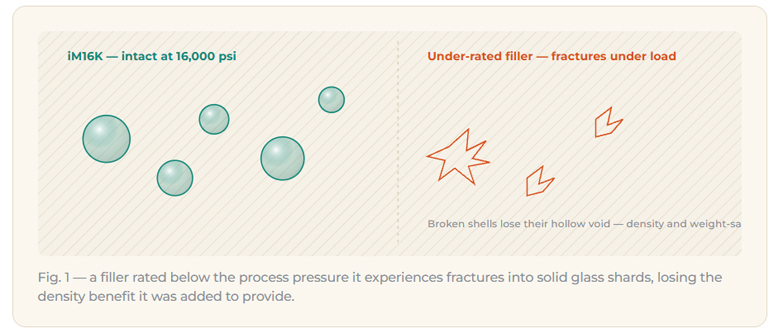
When a glass microsphere's crush strength is lower than the pressure it actually experiences in the barrel or cavity, a portion of the batch fails. The practical consequences show up downstream, not at the point of failure:
DENSITY CREEPS BACK UP
Broken shells lose their hollow void, so the weight reduction the filler was specified for partially disappears — inconsistently, shot to shot.
PART-TO-PART VARIATION
Survival rate can vary with screw speed, back pressure, and gate design, so the same formulation can behave differently from one machine to another.
ABRASIVE WEAR
Fractured glass is sharper and harder on screws, barrels, and gates than intact spheres, accelerating tooling wear throughout production.
SURFACE DEFECTS
Broken particles can appear as surface roughness or splay on cosmetic or sealing surfaces that require a clean finish.
05 Why the rating needs headroom, not just a match
Process pressure isn't a single number you can read once and design to. It varies with wall thickness, flow length, gate size, screw speed, and even shot-to-shot variation on the same press. Specifying a filler rated well above the pressures a part is expected to see — rather than just at the nominal average — is what keeps weight savings consistent across a production run instead of only on the samples pulled for a data sheet.
If you're running long flow lengths, small gates, or multi-cavity tools where local pressure is hard to predict, our applications team can help you check iM16K's rating against your actual process window before you commit tooling.